Imagine a Finland of 100 inhabitants. 51 of them would be women, 13 would be over 70 years old, one would be from Asia and one would hold a Ph.D.
101 For All offers the personal story behind the statistics. Tellervo Kalleinen and Oliver Kochta-Kalleinen visited one hundred homes around Finland and interviewed people about their personal relationship with 30 topics of discussion that tend to divide opinions. The 100 interviewees form a cross-section of the Finnish population in terms of gender, age, region, education, level of income, country of origin and mother tongue. The topics range from immigration to privatisation, and from nuclear power to euthanasia – and not forgetting the health impacts of butter versus margarine.
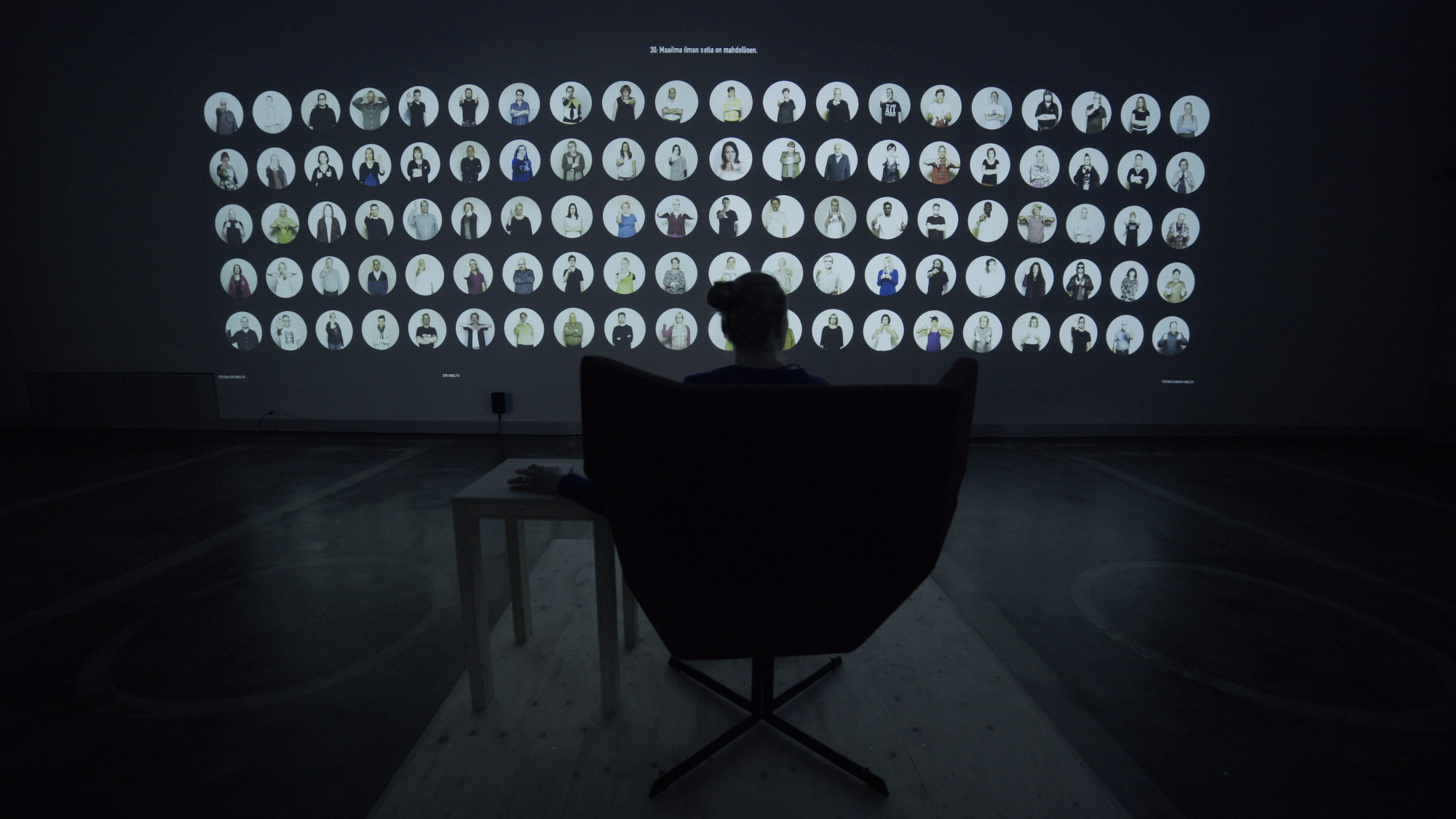
101 For All includes about 65 hours of video interviews. In the “sleep mode” of this interactive video installation only the muted images of the interviewees are visible, projected on wall. Visitors can pick – one at a time – their desired selection of answers from the available topics, and the interviewee that they want to hear speak. The 101th person – as referred to in the title – is the visitor, exposing the piece in his or her own way to other visitors.
A question that arises is that of representation: can one individual or small group of people ever represent ”everyone”? What about the ones left in the margins? The exhibition is based on encounters and reveals how people’s opinions are much more complex, rich and contradictory than what statistics have us believe.
The exhibition challenges to pursue one of the most radical acts of our time, listening to others without prejudice.